Storyboarding, Mapping, Audio & Blocking: Pre-Production Pillars of Way Cool World
April 12, 2026
April 12, 2026
When the green light flashed on Way Cool World, our tiny team didn’t just high-five — we practically floated. The world was already alive in our heads: Antsy McClain’s wild character drawings, James Dalessandro’s tight script and series bible, and Antsy’s original songs that poured color and heart into every corner of Pine View Heights. But ideas alone don’t animate themselves. We needed a rock-solid pre-production plan to turn imagination into smooth 3D reality.
That’s where our four pillars came in — Storyboarding, Mapping, Audio, and Blocking. Together they became the roadmap that keeps our small crew (and our fantastic partners at Cedge Productions in India) moving fast, staying in sync, and loving every frame we create.

3D animation still: Scene from Shady Acres in the early morning
Right after kickoff, our biggest puzzle was the setting itself. We needed a living, breathing small-town map so everyone could picture exactly where Debbie Jo and Antsy’s RV sat in Shady Acres, how the three rows of trailers curved, and where the pine trees met the morning sun.
We sketched Pine View Heights with simple lines and labels — nothing fancy, just crystal-clear geography. Suddenly the opening credits scene clicked into place: Antsy steps out of his RV, newspaper in hand, singing his song of the day, waving at neighbors as the camera glides through the trailer park.
The map didn’t just solve layout questions — it gave our storyboard artist precise camera directions and let the whole team speak the same visual language from day one. No more “wait, which way is the RV facing?” moments. Just pure forward motion.
(Images of our early Pine View Heights map go here — the hand-drawn version and the clean 3D layout we use today.)

Map of Pine View Heights, scene: Antsy says hello to Uncle Ledford
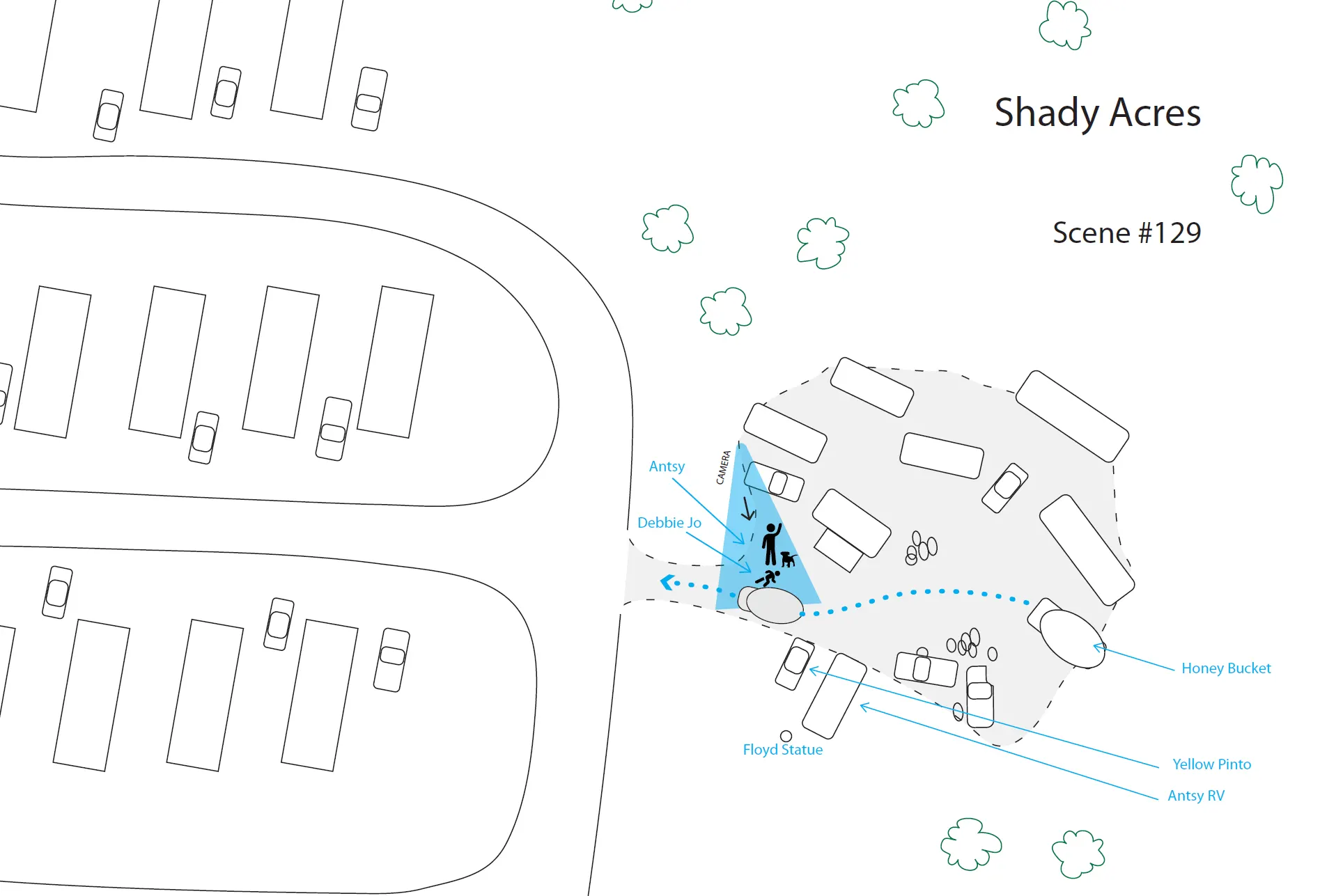
Map of Shady Acres: scene — Debbie Jo climbs into the Spoons Honeybucket truck.
Mapping gave us the stage. Storyboarding turned the script into a flip-book of emotion.
We break the script into panels: every beat, every camera angle, every goofy expression on Antsy’s face or tender glance between him and Debbie Jo. Our storyboard artist draws rough thumbnails first, then tighter versions that show timing, acting, and even rough dialogue balloons.
Because we already have the map, the storyboards feel grounded — we know exactly where characters are standing, which trailer they’re walking past, and how the pine trees frame the shot. It’s like having a comic book version of the episode before a single 3D model is built.
Storyboards catch the little magic moments early: the perfect pause before Antsy sings, the way the morning light hits the trailer windows, the tiny background gags that make Pine View Heights feel alive. They also become our communication bridge with Cedge — everyone sees the same vision, no surprises later.
Before we block a single shot, we start with the dialogue. This early audio pass lets us hear the timing, the relationships, and the emotional rhythm of each scene.
We stay faithful to Antsy McClain’s original songs and the characters he created, but for now we keep the track simple — just the core dialogue. No final music or songs are added at this stage. Even in this stripped-down form, the humor is already working and the emotion is already there.
We’re deep into the audio phase now. It’s a substantial effort, with dozens of files and constant fine-tuning, but everything is moving steadily and sounding better every day. James has a rare director’s touch. He makes every voice artist feel seen, appreciated, and inspired, and that quiet confidence is helping Pine View Heights come alive.
Blocking is where theater tradition meets modern 3D animation — and it’s pure magic for us.
Borrowed from the stage (upstage, downstage, stage left/right from the audience’s view), blocking in Way Cool World means placing low-resolution 3D characters and simple set pieces in a quick-render scene. Cedge builds these “playable” versions super-fast so we can watch the action in real time: Antsy walking to the newspaper box, Debbie Jo waving from the RV steps, the camera swooping through the trailer park exactly as planned.
We review, give notes, adjust timing, and move characters around like actors on a rehearsal stage. Because everything is low-res and fast, changes are cheap and instant. No painful re-renders later. The director gets to feel the scene, the team stays in perfect sync, and we catch storytelling issues while they’re still easy to fix.
Sure, the first low-res blocking passes can look a little... goofy. We’re all visual creatures and sometimes the brain screams, “This looks rough!” But that’s exactly why it works — we’re testing story and emotion, not final polish. The Cedge team listens like pros, tweaks the tiniest details, and always delivers with huge heart.
Early 3D Blocking — The Unpaid Parking Tickets
Early 3D Blocking — Debbie Jo and Judge Smoot
Plain and simple: planning + prototyping = happy team + beautiful show.
— Storyboarding gives the vision.
— Mapping gives the geography.
— Audio gives the soul and rhythm.
— Blocking gives the rehearsal space where we catch mistakes early and celebrate what’s working.
Together they keep us on course, slash disappointment, and turn “wouldn’t it be cool if...” into “look what we just made!”
And the best part? Every time we finish a new blocked sequence, we feel that same electric excitement we had on day one — the day Way Cool World officially became real.
The series is still very much in progress, but the foundation is solid, the team is fired up, and the little town of Pine View Heights is starting to feel like home.
Stay tuned — the next update from the trailer park is coming soon!
— The Way Cool World Crew
(Antsy, James, Michael, JJ and everyone at Cedge making the magic happen)